Ranking first and earning one click: a zero-click case study
First-party Search Console data from a Malaysian education product, showing how a page can hold position one and still return almost no traffic—and what actually moves the number.
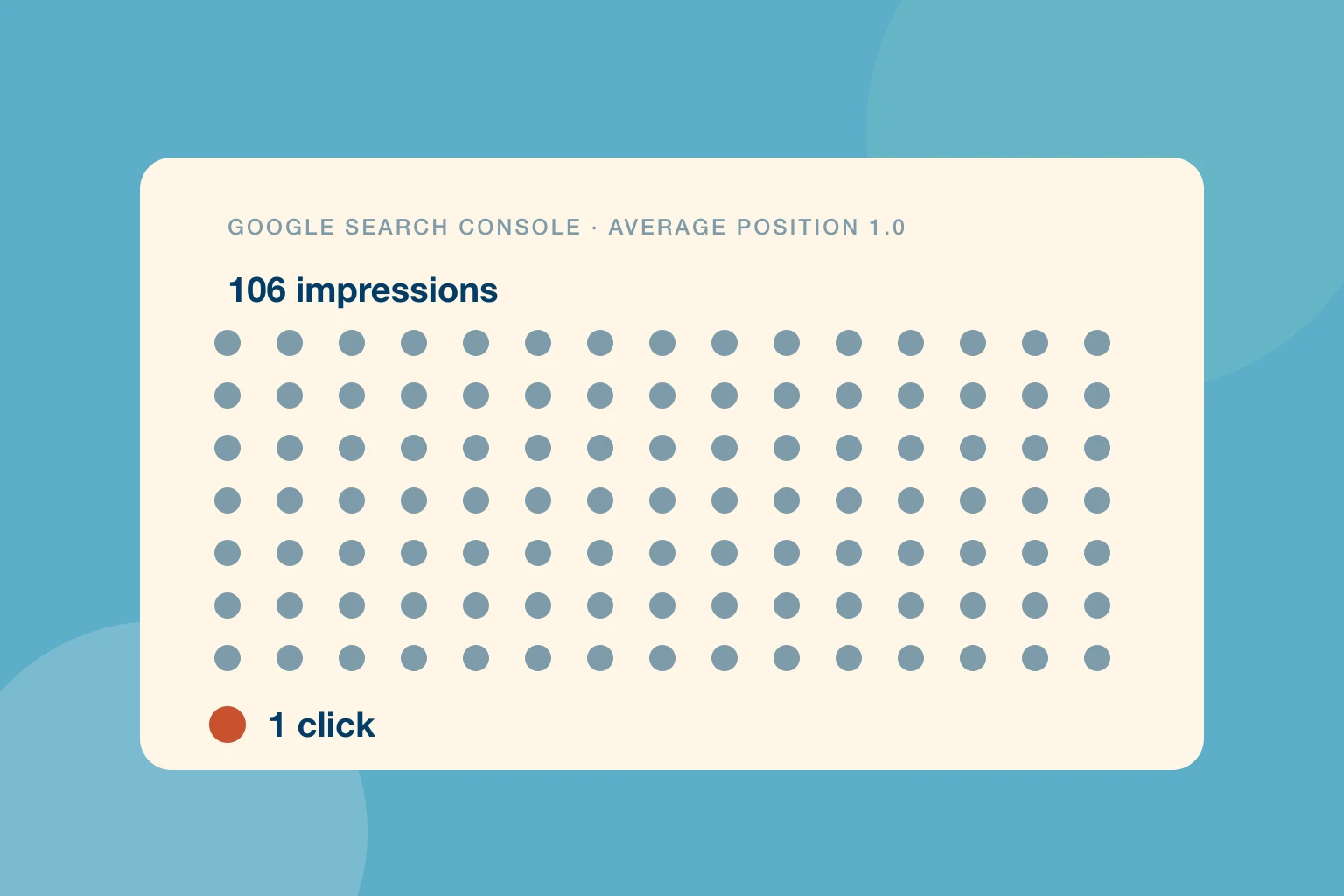
the query that ranks first and returns nothing
We run search for Pawa, an education product for Malaysian primary-school families. One of its explainer pages answers questions about a national assessment: what the grades mean, how marks are reported, when papers are sat.
Over a recent 28-day window that page held an average position of 4.4 on 1,712 impressions and returned 5 clicks. A single query in that set ranked at an average position of 1.0 across 106 impressions and returned one click.
Position one is usually treated as the goal. Here it produced almost nothing, and the reason is visible in the result itself: the question is short, factual and fully answerable on the page of results. A reader who wanted to know what a grade band means has the answer before a click is available to them.
the fix that moved rank but not clicks
Before we changed anything, the same page ran 0 clicks on 151 impressions at position 6.3. Reviewing the page against its competitors made the cause obvious: the meta description ended in the answer. It printed the grade bands in full. Anyone scanning results had no remaining reason to open the page.
So we rewrote the descriptions across that group of pages to describe what the page covers without resolving the question in the snippet. The result was a genuine but partial win. Average position improved from 6.3 to 4.4 and clicks moved from zero to five.
Click-through rate stayed at 0.29%. That is the honest outcome, and it is the useful one: the change fixed what we controlled, and the remaining gap was never ours to close. Google is answering the question, and a description rewrite does not change that.
- Explainer pages in that account ran 0.56% CTR as a class; pages offering practice material ran 2.95%.
- The difference is not writing quality. It is whether the page holds something the result cannot show.
your query report is not your traffic
A second finding matters for anyone reading these reports. On a different page in the same account, the page-level report showed 695 impressions for the period. Adding the query dimension returned 59 impressions across 19 queries.
The gap is not an error. Search Console withholds queries issued by very few people, so rare and conversational phrasings drop out of query-level reports while remaining in the page totals. On a page attracting long, spoken-style questions, most of the demand is invisible at query level.
The practical consequence is a reporting rule: read volume at the page dimension, and treat the query list as a sample of intent rather than an inventory of it. A team optimising only against visible queries is optimising against the minority of its own demand.
what we changed in how we choose targets
The lesson is not that informational content is worthless. It is that a query has a ceiling, and the ceiling is set by whether the answer fits in the result. Deciding that before commissioning the page is cheaper than discovering it after ranking for it.
We now separate targets into questions a result can close and questions it cannot. Definitions, dates, conversions and grade bands belong to the first group; they are worth holding for brand presence and for being cited by AI answer engines, but they should not carry a traffic forecast. Tasks, tools, comparisons and anything requiring the reader to do something belong to the second, and that is where click expectations belong.
For measurement, that means reporting two numbers rather than one. Visibility answers whether the brand is present when the question is asked. Traffic answers whether a click was ever available. Collapsing them into a single ranking dashboard is what produces the report where everything improved and nothing happened.
sources & further reading
make this practical